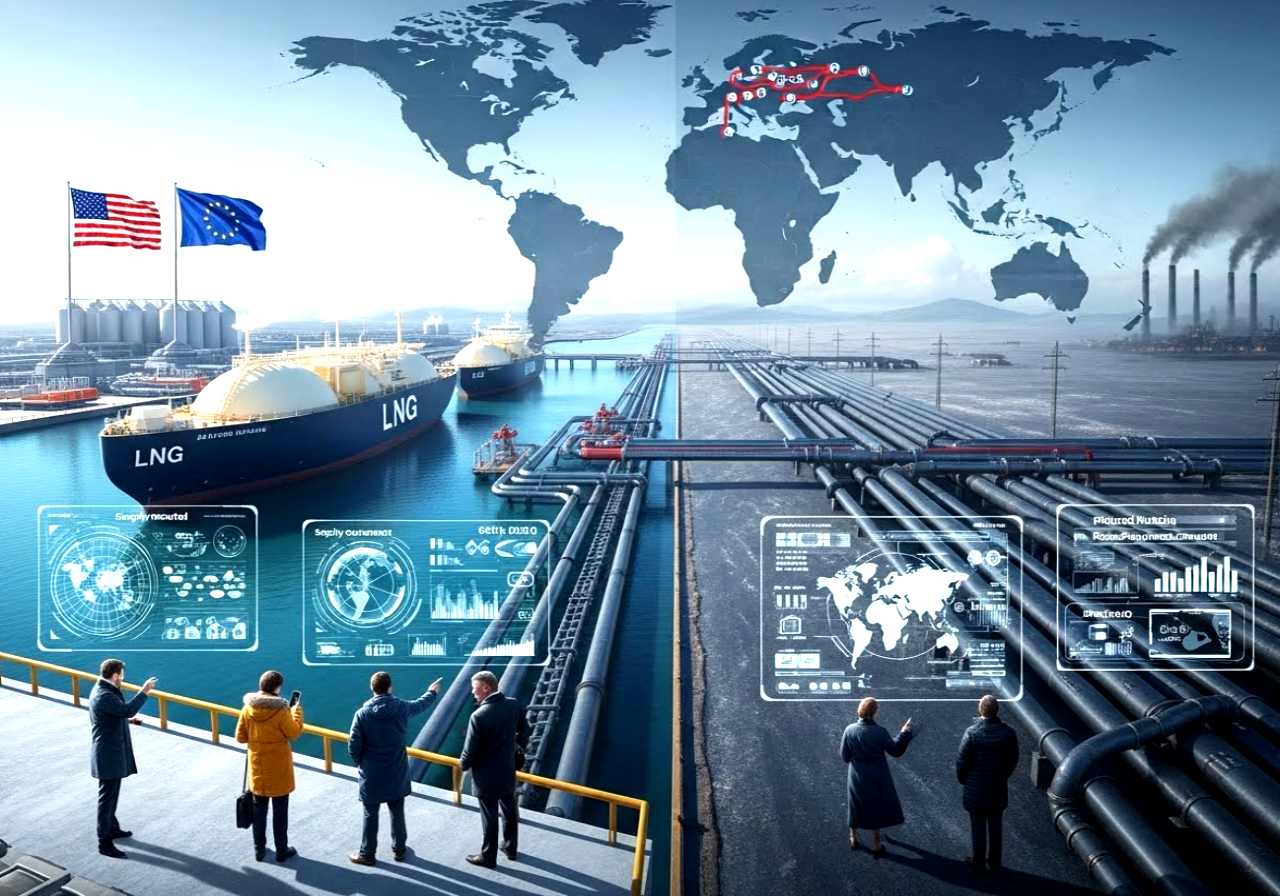
For decades, the relationship between Europe and Russian gas was a defining feature of the geopolitical landscape—a complex web of economic reliance and strategic vulnerability.
But in the wake of recent conflicts, the West, spearheaded by the US, embarked on a mission to completely sever that link. It’s a move that has certainly achieved its primary goal: marginalizing Russian energy influence. However, it has also led to a Dividing World, creating deep fractures in markets and alliances.
This isn’t just about pipelines; it’s about inflation, industrial competition, and the formation of new geopolitical blocs. Here’s a breakdown of the key implications of the US’s strategic intervention in the European energy market.
The Strategic Shift: From Russian Pipelines to US LNG 🚢
The core of the US strategy was simple: replace Russian pipeline natural gas with American Liquefied Natural Gas (LNG). This was achieved through a mix of sanctions, diplomatic pressure, and massive new LNG export deals.
The result? The EU went from depending on Russia for over 40% of its gas to virtually zero, while the US became Europe’s largest LNG supplier.
The EU’s pivot secured energy supply but created a new dependency. Unlike pipelines, LNG is highly mobile and priced globally, exposing European consumers to volatile international spot market prices and a new form of reliance on US export capacity.
This seismic shift came at a high cost, particularly for European industrial competitiveness. While US energy consumers enjoyed relatively low domestic gas prices, European industries faced prices that were often five to ten times higher during the initial crisis phases.
Impact on European Competitiveness and Industry 🏭
For years, cheap, reliable Russian gas was the backbone of European heavy industry—from chemicals to fertilizers to steel. The sudden cutoff acted like an electric shock, forcing shutdowns, production cuts, and, crucially, industrial flight.
The De-Industrialization Threat 📝
Many energy-intensive European companies have announced plans to relocate operations to the US, where energy is cheaper and the government offers generous incentives (like the Inflation Reduction Act). This poses a severe long-term threat to the EU’s economic power:
- Chemical Sector: Loss of basic chemical production, impacting countless downstream industries.
- Fertilizer Production: Skyrocketing gas prices meant producers cut output, risking global food security.
- Long-Term Damage: Once these core industries leave, they are extremely difficult to get back.
The Divided World: New Geopolitical Blocs 🧱
While the West consolidated its energy security, Russia was forced to rapidly reorient its exports, primarily toward Asian markets like China and India, often at heavily discounted prices. This acceleration of East-West energy decoupling is creating two distinct, less-interconnected global energy ecosystems.
| Market Implication | Resulting Global Division |
|---|---|
| LNG Price Premium | Europe pays high, spot-market prices for US/Qatari gas. |
| Russian Gas Discount | China/India secure Russian energy at a deep discount, gaining a competitive edge. |
| Trade Friction | Increased economic tension between the EU and the US over energy costs and subsidies. |
The energy crisis forced Europe to burn more coal initially to compensate for lost gas. This undermined short-term climate goals, even as the long-term plan is to accelerate renewables to end all fossil fuel reliance.
Key Takeaways: A Quick Recap 📝
The US-facilitated energy break-up was a political necessity but an economic shock. Here are the most critical implications:
- New Dependency: Europe traded reliance on Russian pipelines for increased dependency on volatile global LNG markets, primarily sourced from the US.
- Industrial Competitiveness Erosion: High energy prices in Europe drove industry toward the US and Asia, threatening the EU’s manufacturing base.
- Geopolitical Split: The global energy market is fragmenting into two spheres: a Western bloc focused on LNG, and an Eastern bloc securing discounted Russian energy, leading to a “Dividing World.”
The Two-Sided Coin of Decoupling
Frequently Asked Questions ❓
The forced decoupling of European and Russian energy has secured Europe’s immediate strategic independence, but it has profoundly stressed its economic foundation and accelerated the formation of competing global blocs.
The biggest question now isn’t whether Russia is out, but whether Europe can afford the new price of its freedom. What do you think is the long-term impact on the transatlantic relationship? Let’s discuss it below! 😊






Leave a Reply