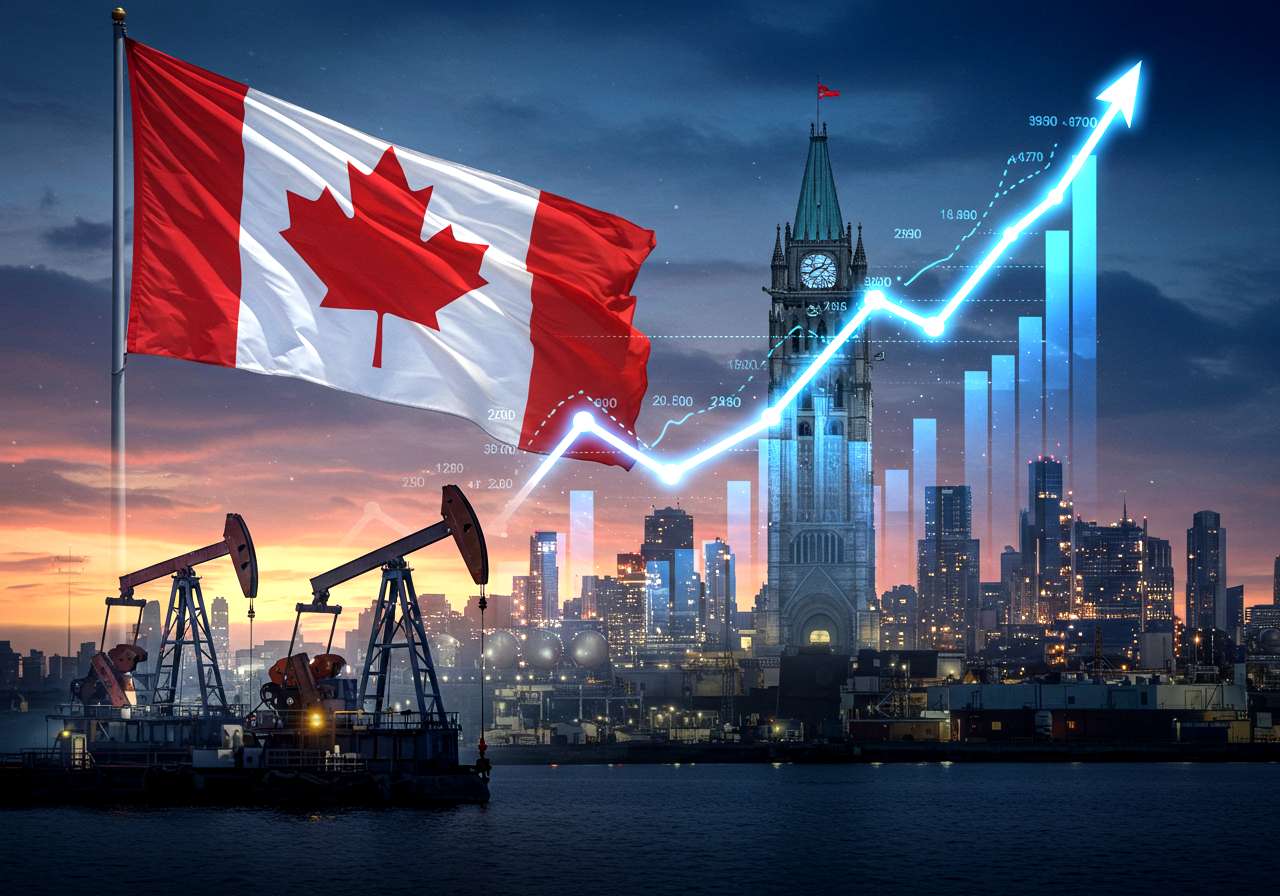
Let’s be honest: the global economy feels like a constant roller coaster these days. But while other nations brace for every market dip, Canada has been demonstrating a remarkable degree of resource resilience. How? It’s all thanks to the steady, strong performance of its commodity sector.
This isn’t just about digging stuff out of the ground; it’s about a foundational economic strength that gives the Canadian government and industry the confidence—and the capital—to invest in the future. We’re going to break down exactly how stable export revenues are fueling Canada’s fiscal space and driving a massive, strategic boom in mining investment. 🇨🇦
The Fiscal Bedrock of Commodity Exports: Gold and Beyond 💎
When we talk about Canada’s commodity exports, we’re covering a huge range—from oil and natural gas to potash and industrial metals. However, the recent news highlights a critical shift: while oil prices have faced volatility, the surge in precious metals, particularly gold, has provided a massive counterbalance.
The Canadian Dollar (the “Loonie”) often acts as a shock absorber. When commodity prices are strong, a weaker CAD can actually boost profitability for exporters, making Canadian goods more affordable internationally and increasing the value of those export revenues when converted back to Canadian dollars.
This robust export performance directly translates into stable government revenues. These revenues, derived from corporate taxes, royalties, and sector-wide economic activity, enhance the government’s fiscal space. Essentially, this is the budget room a government has to maneuver—to pay down debt, fund essential services, or, crucially, launch large-scale strategic investment programs like the Critical Minerals Strategy.
Fueled by Strategy: The Critical Minerals Investment Boom 🔋
This isn’t just a cycle of good luck; it’s a calculated national strategy. The stability provided by traditional commodity exports (like gold) is now being strategically redirected to drive investment in future-focused resources: critical minerals. The federal government’s $3.8 billion Critical Minerals Strategy is a prime example of fiscal space being deployed for long-term economic transformation.
Companies are responding. Investment in exploration and development is surging, particularly for minerals essential to the global energy transition—think lithium, graphite, and copper.
| Investment Focus | Current Role | Future Impact (Goal) |
|---|---|---|
| Gold & Silver | Primary driver of recent export stability and fiscal revenue. | Maintains Canada’s role as a safe-haven producer. |
| Lithium & Copper | Recipient of accelerated government funding and private capital. | Secures Canada’s role in the North American EV battery supply chain. |
| ESG & Tech | Growing focus on automation, AI, and low-carbon processing. | Enhances competitiveness and supply chain traceability. |
North American Synergy 📝
The investment isn’t purely domestic. Incentives like the U.S. Inflation Reduction Act (IRA) have created a powerful synergy, driving Canadian-mined critical minerals directly into U.S. gigafactories. This ensures Canadian miners, backed by stable revenues, are directly integrated into the continent’s most strategic supply chains.
Confidence and Capital: The Market’s Reaction 📊
When a country’s main export sectors are performing well, investor confidence soars. The S&P/TSX Composite Metals & Mining Index recently saw an impressive year-to-date surge, significantly outpacing the broader market. This isn’t surprising—the strong cash flow generated by major producers translates into higher valuations and an improved ability to raise capital.
While gold and critical minerals are booming, the Canadian energy sector still faces pressure from volatile crude oil prices. This divergence—precious metals up, crude oil down—creates a mixed economic picture that requires careful fiscal management by Ottawa to maintain overall stability.
In short, stable revenues from the resource base give investors the green light. It confirms that Canada is a dependable jurisdiction with clear regulatory frameworks and deep geological wealth, encouraging both Foreign Direct Investment (FDI) and the expansion of domestic mining assets.
Key Takeaways: A Quick Recap 📝
Here’s a snapshot of why Canada’s resource sector is such a powerful economic driver right now:
- Safe-Haven Commodities: The surge in gold prices acts as a powerful revenue stabilizer, offsetting volatility in other sectors like oil.
- Enhanced Fiscal Space: Stable export revenues provide the government with the financial capacity to implement large-scale, long-term strategic plans.
- Strategic Investment: This fiscal room is actively funding the Critical Minerals Strategy, shifting focus to future-economy resources like lithium and copper.
- Investor Confidence: Strong market performance (TSX) and government backing make Canada an attractive and dependable destination for global mining investment.
The Canadian Model of Resource Stability
Frequently Asked Questions ❓
Canada’s economic story right now is a masterclass in leveraging current strength for future advantage. By maintaining stable revenues from its core resources, the nation is carving out the financial stability needed to strategically invest in the next era of mining. I hope this guide was helpful! What critical mineral do you think will be the next major revenue driver for Canada? Let me know in the comments below. 😊







Leave a Reply